
 Traitement de pelouse
 Traitement contre les insectes
 Aération de la pelouse
 Amendement de sol
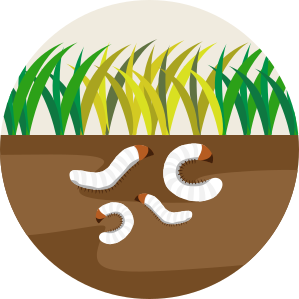 Traitement des vers blancs
 Fertilisation de haies
 Service à la carte
How to Care for Your Lawn in Summer Without Burning It
Quebec summers are the season when your lawn works hardest and is at its most fragile. Heat, drought, foot traffic, insects: between June and August, everything works against it.
The good news is that most summer damage doesn’t come from the weather. It comes from well-intentioned habits: watering 15 minutes every evening, mowing short to stretch out the time between passes, fertilizing in the middle of a heat wave. Fix those three reflexes and your lawn gets through the summer without burning.
4 habits that save your lawn in summer
- Water once or twice a week, 90 minutes to 2 hours in the same spot, early in the morning.
- Mow high: keep the grass above 3 inches (8 cm) and never cut more than one third of the blade height.
- Leave the clippings on the lawn (grasscycling): up to 30% of your fertilizer needs.
- Use liquid fertilizer, high in potassium, and avoid applying it above 86°F (30°C).
When and how long should you water your lawn in summer?
Your lawn needs roughly 2 inches of water per week in summer, rain included. The number is simple. It’s the when and the how long that make the difference between a healthy lawn and a burnt one.
When to water your lawn in summer
In the morning, before sunrise, because that’s when evaporation is at its lowest. That’s the best time to water grass, period.
| Watering time | What actually happens |
|---|---|
| Before sunrise | Minimal evaporation, the water reaches the roots, the lawn dries before nightfall |
| Midday, in full sun | Up to 75% of the water evaporates before it even reaches the soil |
| In the evening | Possible, but the lawn stays wet for hours: an open door to fungal disease |
How long should you water your lawn in summer?
Plan on 90 minutes to 2 hours in the same spot. The goal isn’t to wet the grass, it’s to moisten the top 3 inches of soil, where the roots live.
This is where most homeowners get it wrong: they water a little, often. Light daily watering keeps the moisture at the surface, the roots stay at the surface to reach it, and your lawn becomes even more vulnerable to the next heat wave. Water long, water deep, once or twice a week. That’s it.
cVert expert tip
How do you know your lawn is thirsty? Three signs never lie:
- your footprints stay visible when you walk on it;
- the colour shifts to a dark, almost bluish green;
- the blades fold inward.
And how do you know you’ve watered enough? Push a screwdriver into the soil. If it slides in 3 inches without effort, you’re good. If it stops short, the water didn’t get down there.
Check this before you turn on the hose: nearly every Quebec municipality regulates watering during the summer (odd and even days, time windows, temporary bans). The rules vary from one city to the next, so check your own municipality’s before you set your schedule.
Why is your grass turning yellow in summer?
A lawn turning yellow is usually the result of several factors at once. Before you reach for the hose or the fertilizer, identify the likely cause or causes.
| What you see | Likely cause | What to do |
|---|---|---|
| Uniform, gradual yellowing, hard dry soil | Lack of water (dormancy) | Water deeply, 1 to 2 times a week |
| The lawn yellows right after mowing | Cut too short (below 3 inches or 8 cm) | Raise the blade to 3 inches (8 cm) |
| Regular yellow stripes or streaks | Fertilizer overdose | Water heavily, pause fertilization |
| Dead patches spreading fast in hot weather; the turf lifts like a carpet | Chinch bugs, sod webworms or white grubs | Targeted insecticide treatment: call a pro |
| Yellowing despite good watering and good lawn fertilization | Unbalanced soil pH or compacted soil | Soil test, amendment, lawn aeration |
Yellow doesn’t mean dead: lawn dormancy
Faced with drought, grass cuts off the supply to its leaves to protect its roots: the blades turn brown, but the plant is very much alive underground. A healthy lawn survives several weeks in dormancy and greens up again as soon as the rain returns.
The test: pull on a yellowed tuft. Does it resist and stay rooted? That’s dormancy, so be patient. Does it lift away like a carpet? There’s a good chance insects, white grubs or disease are behind it. That’s when you need to step in.
Is your lawn turning yellow and you don’t know why? We can send a senior technician to assess the situation at your property through our expert diagnostic service.
How do you mow your lawn in summer without damaging it?
In summer, your mower is either your best ally or your worst enemy. It all comes down to cutting height. Set your blade to a minimum of 3 inches (8 cm). That’s higher than what most homeowners do, and it’s exactly what protects your lawn: tall grass shades the soil, holds moisture and stops weed seeds from germinating, which makes it a free ally in your fight against weeds.
The 4 golden rules of summer mowing:
- Never more than one third of the blade height in a single pass.
- Keep your blades sharp. A dull blade tears the grass instead of cutting it: the wound dries out and the tip turns yellow.
- Leave the clippings on the lawn (grasscycling). They supply the equivalent of 30% of your lawn’s fertilizer needs and keep the soil moist.
- During a heat wave, don’t mow at all. Your lawn is already in survival mode and mowing only adds stress. Wait for temperatures to come back down.
cVert expert tip
We often see homeowners cut their grass very short thinking it will stretch out the time between mows. The opposite happens: grass cut too short grows back faster to make up for the leaf surface it lost. Mow high and you’ll mow less often.
What is the best fertilizer for your lawn in summer?
Summer isn’t the time to give your lawn a jolt. If it was properly fertilized in spring, it already has the reserves it needs. In summer the objective changes: you shift from growth mode to protection mode.
Liquid or granular?
Heat slows growth, and excess nitrogen on an already stressed lawn burns it instead of helping it. In hot, dry weather, liquid lawn fertilizer wins:
| Liquid fertilizer | Granular fertilizer | |
|---|---|---|
| Absorption | Immediate, through the leaf and the root | Slow, depends on available water |
| Burn risk | Low, gentler under water stress | Higher: undissolved granules can stress the blades in the sun |
| Watering after application | Wait 24 hours (let it work) | Water daily until the granules disappear |
Same logic after a herbicide or an insecticide: 24 hours without watering, so the product has time to do its job.
Which formulation should you choose?
Go with a fertilizer that’s high in nitrogen (N) and potassium (K). Potassium is the key to summer: it strengthens the lawn’s resistance to heat and drought. As for phosphorus (P), most Quebec soils already contain enough of it, so there’s no need to add more.
cVert expert tip
We adapt our fertilizer type to the weather conditions of each period in the season. That’s the advantage of professional care: the products and the doses adapt to the weather, not the other way around.
How do you protect your lawn during a heat wave?
When the thermometer climbs above 86°F (30°C) for several days in a row, your lawn goes into survival mode.
| Do | Avoid |
|---|---|
| Stop mowing completely | Mowing “just a quick pass” |
| Limit foot traffic and play on the lawn | Any fertilization (pause it) |
| Accept that the lawn will brown | Panic-watering in short bursts |
Your lawn isn’t dead: it’s dormant, and it will green up again as soon as conditions turn favourable.
Recap: the right habits vs the common mistakes
| Right habit | Common mistake | |
|---|---|---|
| Watering | 1 to 2 times a week, 90 min to 2 h, early morning | Every day, 15 minutes, in the evening |
| Mowing | 3 inches (8 cm), sharp blades, grasscycling | Cutting short to stretch out the mows |
| Fertilizer | Liquid in hot weather | Granular in full sun without watering |
| Heat wave | Accept dormancy, stop mowing | Watering and fertilizing more than necessary |
| Insects or white grubs | Watch the patches and call a professional to diagnose and treat | Waiting until the damage is major |
Give your lawn a stress-free summer
Quebec summers are demanding, but with the right treatments at the right time, your lawn will get through the season just fine.
At cVert, our technicians adjust every visit to the season’s changing conditions: liquid fertilizer when it’s hot, insect inspections and white grub control at the right moment. And if a problem comes up between two visits, our service calls are free and unlimited. That means a technician comes back to your property at no charge, as quickly as possible.
Explore our lawn care packages, get your price online in seconds, contact us or call us at 1 844 412-8378.
Frequently asked questions about summer lawn care
My lawn is yellow in summer, is it dead?
No, it’s most likely dormant. Pull on a yellowed tuft: if it resists and stays rooted, the roots are alive and your lawn will green up again when the rain returns. If it lifts away easily like a carpet, the likely cause is an insect or a disease, so contact a professional.
How often should you water your lawn in summer?
Once or twice a week, 90 minutes to 2 hours in the same spot, early in the morning. To check: push a screwdriver into the soil after watering. If it slides in 3 inches easily, that’s enough.
What is the best fertilizer for a lawn in summer in Quebec?
A liquid fertilizer high in potassium: potassium helps the grass resist heat and hold its water. As much as possible, avoid fertilizing above 86°F (30°C), especially with a granular product, because the lawn is dormant and simply can’t absorb it.
Should you water after a lawn treatment in summer?
It depends on the product. After a granular fertilizer: water daily until the granules are no longer visible. After a liquid fertilizer, a herbicide or an insecticide: wait 24 hours. Your cVert technician confirms this at every visit through an email report and a posted lawn sign.
Can I mow during a heat wave?
No. A lawn under water stress has a hard time recovering from a mow. Wait until the weather turns milder.
